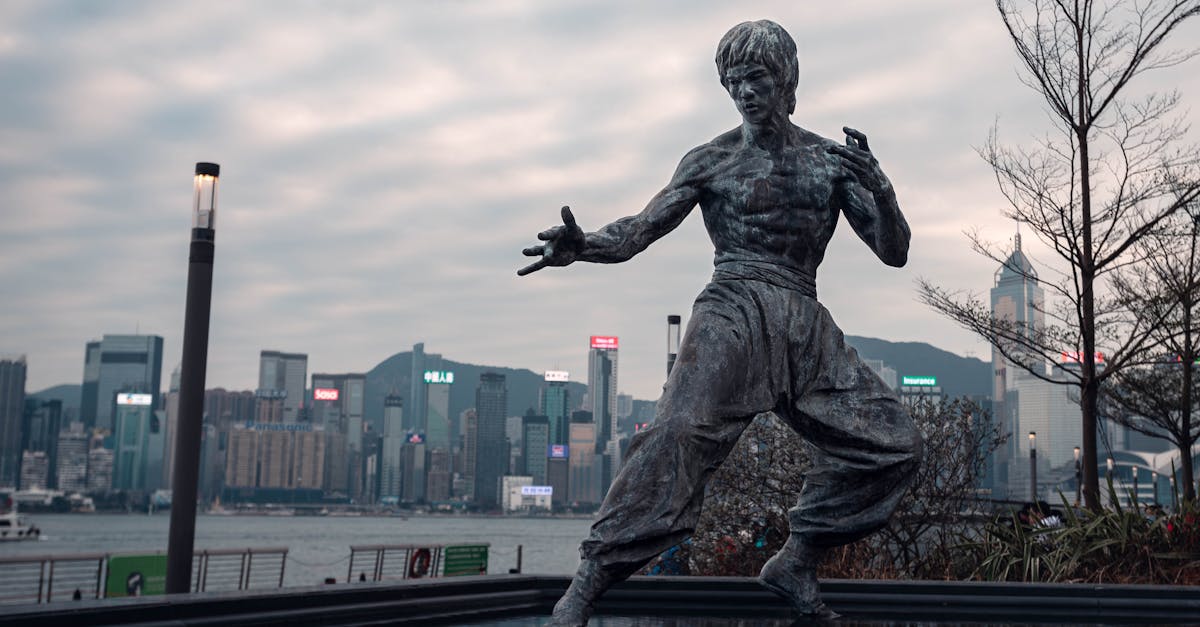
Few cultural figures have transcended their original field the way Bruce Lee did. More than a martial artist or a movie star, Bruce Lee became a symbol of self-expression, discipline, and personal freedom. His influence still reaches far beyond combat sports, touching philosophy, cinema, fitness, and even modern self-development culture. Understanding how philosophy and martial arts blended in his life helps explain why his legacy remains so powerful decades after his death.
Bruce Lee’s journey began in Hong Kong, where he was exposed early to both Eastern philosophy and street fighting. As a teenager, he trained in Wing Chun, a traditional Chinese martial art focused on efficiency, balance, and close-range combat. Yet even at this early stage, Lee showed dissatisfaction with rigid systems. He noticed that real fights rarely followed fixed patterns, and that tradition sometimes limited adaptation rather than enhancing it. This realization planted the seeds for his lifelong philosophical approach to combat and life itself.
When Bruce Lee moved to the United States, his ideas expanded dramatically. He studied philosophy formally at the University of Washington, reading thinkers like Laozi, Zen Buddhist texts, and Western philosophers. These influences shaped his belief that martial arts were not merely about fighting techniques but about understanding oneself. For Lee, combat was a mirror: flaws in movement revealed flaws in thinking. This connection between mind and body became central to his teaching.
Out of this fusion emerged Jeet Kune Do, Lee’s personal martial arts philosophy rather than a traditional style. Jeet Kune Do emphasized adaptability, simplicity, and directness, rejecting fixed forms and unnecessary movements. The famous phrase “be like water” captured this idea perfectly: water flows, adapts, and changes shape without resistance. While often quoted today, this concept is frequently misunderstood. Lee was not advocating softness alone, but responsiveness — the ability to shift between hardness and fluidity depending on the situation.
What many people forget is that Bruce Lee’s philosophy was deeply practical. He obsessively tested ideas through sparring, conditioning, and experimentation. His physical training routines were years ahead of their time, incorporating weightlifting, cardiovascular conditioning, and flexibility work when many martial artists still believed strength training was harmful. This scientific mindset helped redefine how fighters trained and contributed to the evolution of modern mixed martial arts.
Lee’s philosophy also played a crucial role in his impact on cinema. At a time when Asian characters were often stereotyped or sidelined, Bruce Lee presented a confident, powerful, and intelligent image. Films like Enter the Dragon introduced global audiences to martial arts not as exotic spectacle but as a serious discipline tied to personal identity and philosophy. His on-screen presence was inseparable from his beliefs: controlled aggression, emotional restraint, and clarity of purpose.
Another often overlooked aspect of Bruce Lee’s legacy is his emphasis on individual expression. He repeatedly warned against blindly copying instructors, traditions, or even himself. In his view, true mastery meant discovering what worked for you, physically and mentally. This idea resonated strongly with later generations, especially in cultures increasingly skeptical of rigid authority and inherited rules.
His philosophical writings, later compiled in Tao of Jeet Kune Do, reveal a thinker concerned with ego, fear, and self-limitation as much as punches and kicks. Lee believed that the greatest opponent was internal — doubt, rigidity, and the need for validation. This insight is a key reason his words continue to circulate far beyond martial arts communities.
Bruce Lee’s life was tragically short, but his synthesis of philosophy and martial arts created something timeless. He showed that combat could be intellectual, that physical training could be philosophical, and that self-knowledge was the ultimate form of strength. In doing so, he became more than a fighter or an actor — he became a global icon whose ideas still challenge people to move, think, and live with greater awareness.